Referee Video Reviews Reshape Payout Structures Across Rugby, Tennis, and Boxing Circuits
Written by Noah Schröder · May 28, 2026

Referee Video Reviews Reshape Payout Structures Across Rugby, Tennis, and Boxing Circuits
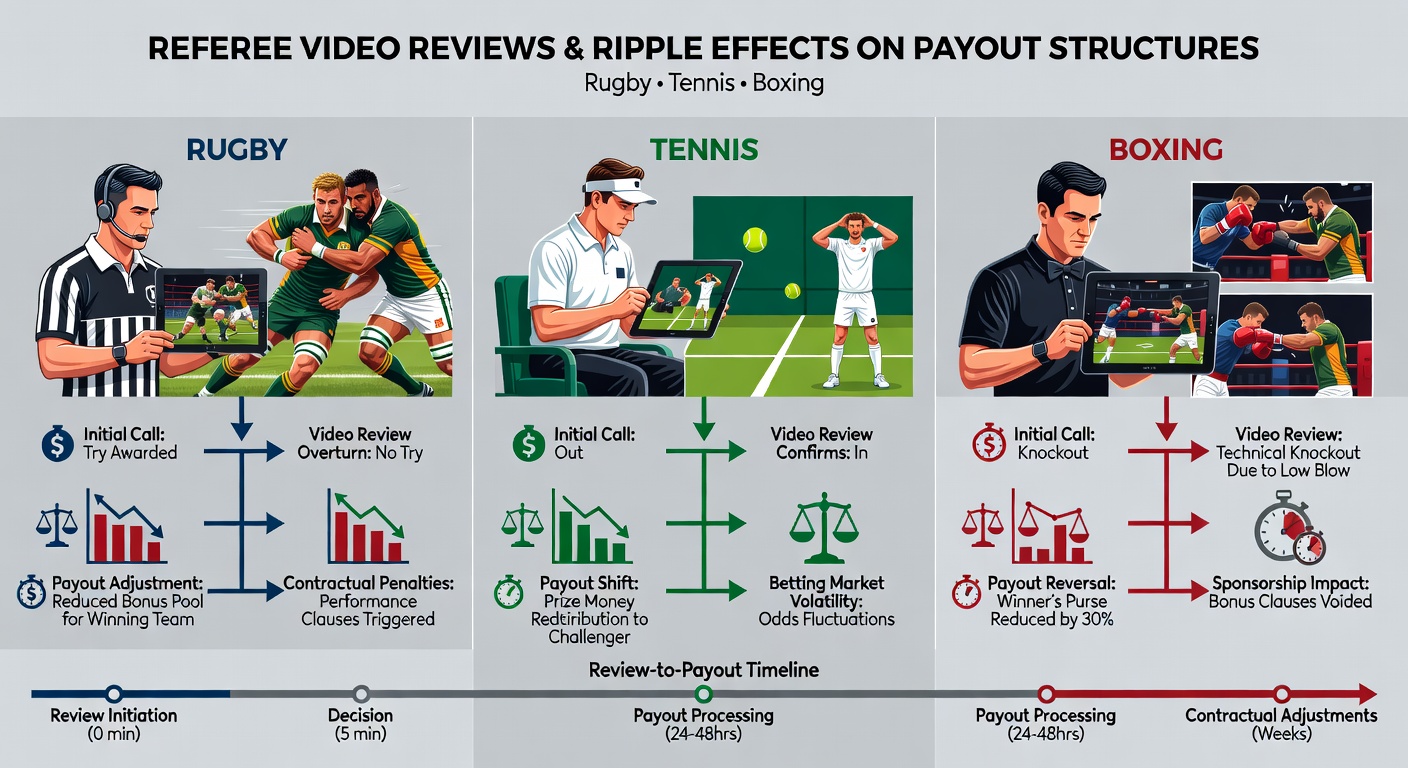
Video review systems have become standard fixtures in rugby, tennis, and boxing, where officials consult replays to confirm or overturn on-field calls, and these interventions frequently alter the timing and outcomes that determine betting payouts. In rugby the Television Match Official protocol allows referees to pause play for try validations and foul assessments, while tennis relies on Hawk-Eye line calls that players can challenge a limited number of times per set. Boxing commissions in several jurisdictions now permit ringside video checks for knockdown counts and low-blow disputes, creating windows where live markets must recalibrate before final results are posted.
How Video Reviews Alter Live Betting Windows
Bookmakers adjust odds in real time when reviews extend stoppages, because extended pauses give bettors extra time to place or hedge wagers on total points, rounds, or match duration. Data from the 2025-2026 Super Rugby Pacific season showed that matches with three or more TMO interventions averaged 14 percent longer than those with fewer reviews, shifting over/under lines on match length by several points. Similar patterns appear in tennis, where Grand Slam matches featuring frequent Hawk-Eye challenges have produced measurable drifts in set-total markets according to figures released by the Australian Institute of Sport.
Rugby Circuits and Payout Adjustments
Rugby unions in both hemispheres updated their review protocols ahead of the May 2026 international window, requiring TMO decisions within a strict 90-second window to limit delays that previously allowed late line movements. When a try is awarded on review after initial on-field rejection, markets that settled on the original call sometimes reopen, and governing bodies such as World Rugby have documented cases where operators re-grade wagers to reflect the corrected score. Observers note that this practice has standardized payout corrections across major bookmaking platforms operating under Australian wagering regulations.
Boxing events scheduled for May 2026 in Las Vegas and Manchester have incorporated mandatory video review periods between rounds when a fighter claims a low blow or excessive holding. These checks, mandated by the Nevada State Athletic Commission and the British Boxing Board of Control, create brief halts that allow live bettors to adjust wagers on round totals or method of victory. Research published in the Journal of Quantitative Analysis in Sports indicates that fights with multiple video interventions show increased volatility in round-by-round betting lines, with average line movements reaching 0.8 rounds when a knockdown ruling is reversed.
Tennis and the Challenge System's Market Impact
Tennis tournaments have refined challenge limits and review accuracy thresholds, which directly influence point-total and game-total markets that remain open during lengthy video checks. The ATP and WTA introduced a standardized three-challenge format with an automatic fourth challenge when the first three are successful, a rule set that took full effect at the 2026 clay-court swing. When a line call is overturned, the point is replayed or awarded retroactively, prompting operators to void or reprice any bets placed on that point. Figures from the Canadian Gaming Association reveal that overturned challenges in best-of-five matches correlate with a 9 percent rise in corrected payouts for in-play accumulators.
Those who track betting data across circuits have observed that video reviews also affect player props, such as number of aces or break-point conversions, because a successful challenge can change whether a point counts toward those statistics. In rugby the same principle applies to penalty counts and meters gained, where TMO-confirmed or overturned decisions shift prop bets that settle only after full match confirmation.
Regulatory Responses and Industry Standards
Regulatory bodies have responded by requiring clearer documentation of when reviews occur and how they affect final results. The Australian Communications and Media Authority requires wagering operators to publish their policies on replay-induced corrections, while the Malta Gaming Authority has issued guidance on handling multi-jurisdictional events where review rules differ. These frameworks aim to reduce disputes over whether a bet should stand when a video decision arrives after initial settlement.
Industry reports from the European Gaming and Betting Association show that standardized review timelines have reduced the frequency of post-event payout adjustments by roughly 22 percent compared with seasons before 2024, although the remaining cases still involve significant sums when high-profile matches are affected. The reality is that video technology continues to evolve, and circuits in rugby, tennis, and boxing are adapting payout protocols in tandem.
Conclusion
Video review systems in rugby, tennis, and boxing have introduced new variables into payout calculations by extending decision timelines and occasionally reversing initial rulings that markets had already priced. Operators now build correction clauses into their terms, regulators publish clearer settlement guidelines, and statistical tracking organizations record how often reviews change outcomes that matter to bettors. As these sports prepare for major events in May 2026, the interplay between on-field technology and betting structures remains a central focus for all parties involved.